How Do I Write an SEO-Friendly Blog for a Small Business? (Your 2026 Playbook)
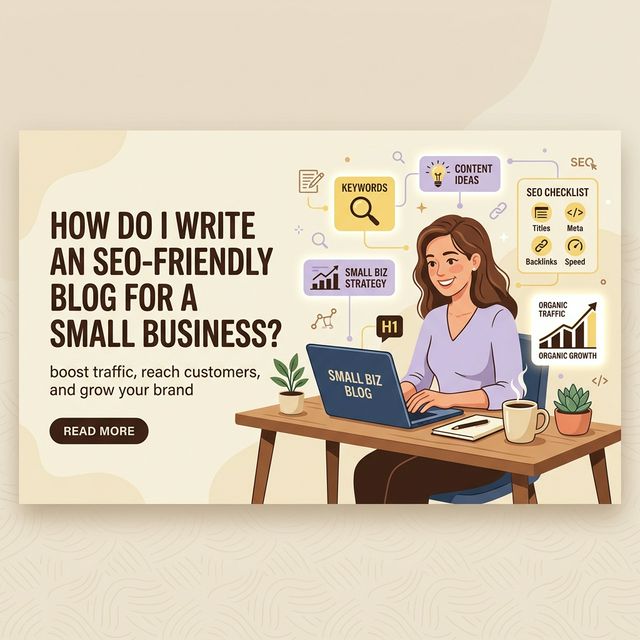
What Is an SEO-Friendly Blog Post?
An SEO-friendly blog post is a piece of written content deliberately structured to rank on search engines and genuinely answer a reader's question. It combines a targeted keyword, a logical heading hierarchy, and trustworthy information — all in one readable page.
The "SEO" part is not about stuffing keywords everywhere. Search engines like Google have been sophisticated enough for years to penalise that behaviour.[1] What they actually reward is content that matches search intent — meaning the post gives the person exactly what they came looking for, fast.
For a small business, that means your blog post about "how to choose a local plumber" should answer that question completely, written for a human first, with a search engine simply able to understand it clearly.
Why Does Blogging Still Work for Small Businesses in 2026?
A well-optimised blog compounds over time. Unlike paid ads that stop the moment your budget runs out, a single strong blog post can drive free organic traffic for years. According to HubSpot's 2025 State of Marketing report, businesses that blog consistently generate 3.5× more traffic than those that don't.
Small businesses are uniquely positioned to win at local and niche SEO. Large brands chase high-volume, competitive keywords. You can own the specific long-tail terms your ideal customers actually type — phrases like "best gluten-free bakery in Austin" or "how to fix a leaking tap without a plumber."
Google's 2025 Search Quality Rater Guidelines explicitly prioritise Experience, Expertise, Authoritativeness, and Trustworthiness (E-E-A-T). A small business owner who writes from genuine hands-on experience has a real edge over generic, AI-spun content farms.[2]
The compound return is the key insight: one post that ranks in position 3 for a 500-search-per-month keyword drives roughly 75–100 visits per month, indefinitely — at zero additional cost after the writing is done.
How Does Google Actually Rank a Small Business Blog?
Google ranks pages by assessing three things in order: relevance (does this page answer the query?), authority (do other reputable sites link to it?), and experience (does the page load fast and work on mobile?). Nail relevance first — it's the only factor entirely within your control from day one.
The ranking algorithm weighs hundreds of signals, but for a new small business blog, three of them matter most immediately:
- Keyword relevance — your post clearly targets one specific phrase and answers it thoroughly.
- On-page structure — proper use of H1, H2, H3 headings, short paragraphs, and an internal linking strategy.
- Technical basics — mobile responsiveness, page speed under 3 seconds, and an SSL certificate (HTTPS).
Backlinks (links from other sites) do matter, but they're a longer-term game. In the first six months, focus on relevance and structure — those are free and fully in your hands today.
DIY vs. Done-for-You Blogging: Which Strategy Actually Wins?
DIY blogging costs nothing but time and is ideal if you have 3–4 hours per week and enjoy writing. Done-for-you services cost €19–€99/month but free up your time entirely. The right choice depends on whether your bottleneck is budget or bandwidth.
| Factor |  DIY Blogging DIY Blogging |
 Done-for-You Service Done-for-You Service |
 Hybrid (AI-assisted) Hybrid (AI-assisted) |
|---|---|---|---|
| Monthly cost | €0 (your time) | €19–€299+ | €0–€50 |
| Time per post | 3–6 hours | 0 hours | 30–60 minutes |
| Brand voice accuracy | High | Medium (with briefing) | Medium–High |
| SEO optimisation depth | Depends on skill | High | High (with right tools) |
| Scalability | Low | High | High |
| Best for | Solo founders, side businesses | Growing SMBs, agencies | Time-pressed owners who want control |
Most small businesses start with DIY to learn what resonates with their audience, then graduate to a hybrid or done-for-you model once they see traction. Either way, the structure of a good post is identical — which is what the next section covers.
The 7-Step Process to Write an SEO-Friendly Blog Post
The process runs in order: pick one keyword, validate it has search volume, outline your headings, write an answer capsule for each section, fill in supporting detail, add internal links, then publish and submit to Google Search Console. Seven steps, one sitting.
- Step 1 — Choose ONE keyword. Use Google Search Console (free), Ubersuggest free tier, or simply type your topic into Google and read the "People Also Ask" box. Pick a phrase with 100–2,000 monthly searches and low competition. Long-tail keywords (4+ words) are your best friend.
- Step 2 — Analyse search intent. Type your keyword into Google and study the top 5 results. Are they listicles, how-to guides, or product pages? Match that format. Google already knows what searchers want — mirror it.
- Step 3 — Build a heading skeleton. Write your H1 (matches the keyword naturally), then draft 4–6 H2 headings as questions your reader would ask. This gives you your outline before you write a single paragraph.
- Step 4 — Write the answer capsule first. Under every H2, write a 30–50-word paragraph that fully answers the heading question. If you published only these, a reader would still leave informed. This is the most important habit in modern SEO writing.
- Step 5 — Add supporting context and evidence. Below each answer capsule, write 2–4 short paragraphs (2–3 sentences each) with examples, data, or step-by-step instructions. Cite a real source — a study, a government resource, or a reputable publication — at least once per section.
- Step 6 — Interlink deliberately. Add 2–3 internal links to other pages on your site (service pages, related posts). Add 1–2 external links to authoritative sources. This builds topical authority and helps Google crawl your site.
- Step 7 — Optimise meta + publish. Write a meta title (55–60 characters, keyword near the front) and meta description (150–155 characters with a clear call to action). Publish, then submit the URL in Google Search Console under "URL Inspection → Request Indexing."
A post built on this skeleton consistently outperforms longer, unstructured posts. According to Semrush's 2025 Content Marketing Report, structured articles with clear heading hierarchies receive 40% more organic impressions than equivalent unstructured content.[3]
What Are the Biggest SEO Blogging Mistakes Small Businesses Make?
The three costliest mistakes are: targeting keywords that are too competitive, writing for search engines instead of humans, and publishing once then never again. Any one of these kills momentum; all three together guarantee failure.
- Targeting "best coffee shop" instead of "best espresso bar in [your city]." Hyper-local and niche long-tail keywords have far less competition and far more buying intent.
- Keyword stuffing. Repeating the primary keyword every 50 words reads unnaturally and triggers Google's spam filters. Aim for one mention in the H1, one in the first 100 words, and natural variation throughout.
- Skipping the meta description. Google writes one for you if you don't — and it rarely picks the best excerpt. A hand-written meta description can lift click-through rate by 5–10%.[4]
- No internal linking strategy. Every new post should link to at least one existing page on your site. Isolated posts are invisible to Google's crawlers.
- Inconsistent publishing. One post per quarter won't build topical authority. Aim for at least two posts per month. Consistency beats perfection every time.
Key Takeaways
- An SEO-friendly blog post answers one specific search query with a clear structure, short paragraphs, and proper headings.
- Small businesses win by targeting long-tail, local, and niche keywords that big brands ignore.
- The answer capsule method — a 30–50-word direct answer under every H2 — is the single highest-impact writing habit for 2026 SEO.
- Publish at a minimum twice a month, interlink every post, and submit to Google Search Console immediately after publishing.
- DIY is viable; a hybrid AI-assisted workflow cuts production time from 4–6 hours to under 1 hour without sacrificing quality.
Frequently Asked Questions
How long should a small business blog post be?
For most small business topics, 1,200–1,800 words is the sweet spot. That's long enough to cover a topic with authority, short enough to keep readers engaged. Longer posts (2,500+ words) make sense only for genuinely complex topics where comprehensive coverage is what the searcher needs.
How often should a small business post a new blog?
Two posts per month is a realistic and effective baseline for most small businesses. Consistency matters more than volume. Two high-quality, well-structured posts every month will outperform eight rushed, thin posts in the same period — both in rankings and in reader trust.
Do small business blogs still matter with AI search becoming more common?
Yes — arguably more than ever. AI-generated search summaries (like Google's AI Overviews) pull directly from well-structured, authoritative blog posts. Content written with clear answer capsules and cited sources is exactly what AI search engines quote. Your blog becomes a source for AI answers, not a competitor to them.
What free tools can I use for keyword research as a small business?
Google Search Console (free, essential), Google's "People Also Ask" and autocomplete, Ubersuggest's free tier (3 searches/day), and AnswerThePublic's free tier are the most useful. For local businesses, Google Business Profile Insights also shows what search terms people use to find you — a goldmine often overlooked.
Should I use AI to write my small business blog posts?
AI works best as a drafting and structuring assistant, not a ghostwriter you publish unedited. Use it to generate an outline, draft answer capsules, and suggest related keywords. Then add your real-world experience, specific examples from your business, and your genuine voice. That combination — AI efficiency plus human expertise — is what Google's E-E-A-T framework rewards in 2026.
Glossary
- Answer Capsule
- A 30–50-word paragraph placed directly beneath an H2 heading that delivers a complete, self-contained answer to the heading question. Designed to be quoted by AI search engines and featured snippet algorithms.
- E-E-A-T
- Experience, Expertise, Authoritativeness, and Trustworthiness — Google's framework for evaluating content quality. First-hand experience is the "Experience" addition introduced in 2022 and remains a strong ranking differentiator.
- Long-Tail Keyword
- A search phrase of four or more words that is highly specific and typically has lower search volume but significantly higher conversion intent. Example: "best accountant for freelancers in Dublin" vs. "accountant."
- Meta Description
- The 150–155-character summary that appears beneath your page title in Google search results. It does not directly influence rankings but strongly influences whether a searcher clicks your link.
- Search Intent
- The underlying goal a person has when typing a query into a search engine. The four main types are informational (learn something), navigational (find a website), commercial (compare options), and transactional (buy something).
- Topical Authority
- The degree to which Google perceives your website as a trusted expert on a specific subject, built by consistently publishing related, interlinked content on the same topic cluster.
- Internal Link
- A hyperlink from one page on your website to another page on the same website. Internal links help search engines discover and understand your content structure and distribute ranking power across your site.
Sources & Further Reading
- Google Search Central. "Creating helpful, reliable, people-first content." developers.google.com (2025).
- Google. "Search Quality Rater Guidelines." guidelines.raterhub.com (2025).
- Semrush. "State of Content Marketing 2025 Global Report." semrush.com (2025).
- Backlinko. "Google Click-Through Rate (CTR) Statistics." backlinko.com (2025).
- HubSpot. "State of Marketing Report 2025." hubspot.com (2025).

Stop Overpaying for Blog Posts.
FreshPosts writes 4 blog posts per month for €19. We publish them to your WordPress site automatically. Try 2 posts free.
Get 2 Free Posts